
Ear training is something that musicians tend to either:
Because e.g. their music course or instrument exams require it.
Thinking it’s completely separate from instrument learning,
associated with music theory,
or for expert musicians only.
But ear training is something which should be core to every musician’s development from the very beginning—and not just “because some teacher said so!”
There is one big reason to do ear training:
becauseyou will be a better musician.
All those soft intangible things which distinguish an average musician from a fantastic and inspiring one – they’re all in the ear!
 Don’t just take our word for it though.
Here are 10 powerful reasons to make ear training part of your music learning:
#1: Hear More Details in Music
Do ear training and you’ll discover you become more and more aware of the rich detail in music.
Discover new dimensions in the music you know and love, as your ears become more musically sensitive.

#2: Accuracy
As your ears become more sensitive to detail, it will make you a far more accurate player.
After all, you can only play precisely if you can hear whether your playing is precise or not!
#3: Enjoyment
You’ll rediscover music you thought you knew, hearing it afresh with your newly-enhanced ears. You’ll also find yourself enjoying a much broader range of music styles because you can appreciate new aspects of music.
If you love music, there are few things better in life than finding ways to enjoy music even more—ear training provides this over and over again!

#4: Understanding Music Theory
Learning to truly understand what you’re hearing in music is enormously empowering.
You’ll wonder how you went so long without this musical intelligence!
#5: Creativity
Your broader appreciation and increased musical sensitivity will help you build up your musical vocabulary.
Understanding what you hear lets you choose which rules to obey and which to ignore.
Together these give you far greater musical creativity in improvisation, song-writing and composing.

#6: Playing By Ear
One of the most fun things you can do in music: play by ear!
With no written aids or reliance on anything but you and your instrument you can express yourself directly in music.
#7: Versatility
Ear training builds your appreciation of different musical elements—from chords, to instruments, to genres, and more—and your ability to instinctively mimic and utilise them on your instrument.
This makes you a more well-rounded and versatile musician, welcome in any group, and capable of playing in any situation.

#8: Confidence
One of the greatest benefits for many musicians who pursue ear training: finally escaping that nervousness about musical performance.
When you’ve built up your aural understanding with ear training, you don’t need to fear anything in music. You know you can always trust your ears and perform with confidence.
#9: Musical Communication and Conversation
A large part of ear training is associating sounds with their corresponding names.
Learning this shared terminology for musical elements lets you talk about music more easily and intelligently with other musicians.
It also lets you have conversations in music by closing the gap between musical ideas in your head and expressing them in the real world through your instrument.
#10: Freedom
This is the big one.
If we had to sum up the benefits of ear training in one word, it would be: freedom.

“Musical freedom” means:
This is the true sign of a “natural musician”, and it’s something which you too can obtain—through dedicated ear training practice.
Frequently Asked Questions
Why is ear training important?
Ear training develops the skills musicians use constantly in their musical lives. Whether you’re performing, producing audio, or simply listening, these abilities form the foundation of musical understanding. The skills you improve through ear training directly enhance your practical musicianship beyond abstract theory.
Why is ear training so difficult?
Many musicians struggle because they’ve only encountered ear training in dry, abstract music theory formats, particularly through formal exams. This academic approach creates what experts call ‘the ear training trap’—a common mistake that makes the process feel disconnected from real musical practice.
Can you retrain your ears to hear better?
Yes, your musical ear is absolutely trainable. Ear training encompasses anything you do to improve your auditory skills, from structured interval recognition exercises to active listening with your favorite music. These are skills you can develop and strengthen over time through consistent practice.
What’s the point of ear training for musicians?
The point of ear training is improving the abilities you actually use as a musician. It’s not just academic exercises—ear training means anything that develops your musical ear, whether that’s formal interval work or thoughtful listening. These skills directly support your everyday musical activities.
Does ear training have to be music theory exercises?
No, ear training can be as structured as interval recognition or as loose as active listening with your favorite music. While traditional approaches focus on dry theory and exams, effective ear training includes any activity that helps you hear and understand music more deeply.
How Long Should You Practice Ear Training?
It doesn’t take hours and hours, locked away doing ear training drills, to see real results. In fact, trying to do too much in one session can actually hold you back!
Success in ear training boils down to doing it a little and often.
Practice Every Day for Best Results
If you want to develop your musical ear effectively, daily practice is the way to go. Your goal with ear training is to embed musical habits and patterns in your mind through consistent listening. This requires regular, repeated encoding of musical stimuli in your head.
Studies show it takes two to three weeks to acquire a daily habit. When you practice intensely every day for at least three weeks, you’re gaining not just the ear skills, but the valuable habit of training your ears.
Once that habit forms, ear training stops feeling like a chore. It becomes as automatic as brushing your teeth in the morning or drinking your coffee. That’s when you really start gaining the long-term benefits!
How Long Should Each Session Be?
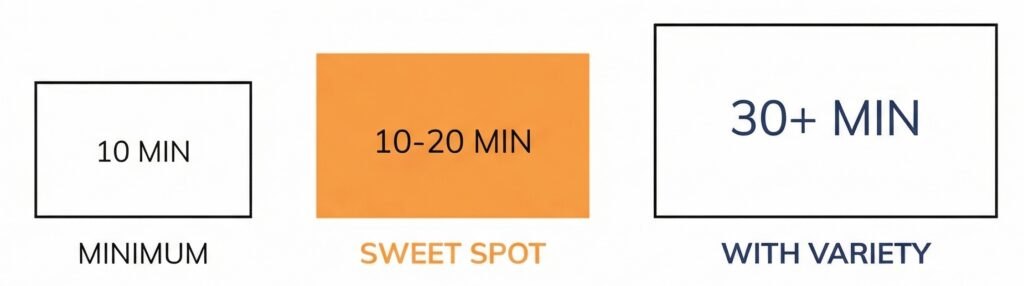
The absolute minimum: We’d recommend at least 10 minutes a day of dedicated ear training practice. This is enough to maintain your skills and keep progressing.
The sweet spot: Aim for 10-20 minutes of dedicated practice, ideally allowing another 10-20 minutes for integrating it with your instrumental practice. For example, you might spend 15 minutes drilling chord progressions, then another 15 minutes playing through those same progressions on your instrument or improvising over them.
If you have more time: 30 minutes/day is an excellent amount of time to dedicate to ear training and will give you satisfying results. However, many people find their ears tire after 15-20 minutes of determined practice. The solution is to ensure variety. 30 minutes of pure interval drills will be exhausting… but a mix of intervals, chords, and playing by ear can easily fill 30+ minutes without wearing you out.
Don’t Overdo It!
Determination is admirable, but it’s a mistake to spend too long in one session.
Your ears fatigue quickly, especially when you’re first starting out. You can actually reach a point where you start getting worse during a session rather than better! Practice only until your ears start to feel tired or you feel you’re not making progress. Then take a break.
As a rule of thumb, spend no more than 5-10 minutes on any single exercise. If you have a longer practice session planned, tackle a wide variety of exercises rather than grinding away at one thing.
Your brain needs time to digest and process what you’ve practiced. There’s a lot of subconscious learning happening with ear training, and it needs space to develop naturally. You can’t force it to happen faster by pushing through exhaustion, that will only backfire on you.
When Should You Practice?
Should you practice in the morning or at night? It’s up to you!
If you’re a morning person and you tend to concentrate better in the early hours, do your ear training in the morning. If you’re the lunch-or-afternoon-break type, practice in in those breaks. If you’re a night owl, it’s fine to do it at night.
The time of day is not as important as your ability to concentrate and ward off distractions as you practice.
And see above re: “guerilla practice”: Sneak in a few minutes of ear training here and there throughout the day. The beauty of this approach is that it can be done without access to your instrument, making it perfect for “stolen moments” amid a busy schedule.
Stay Consistent
It is far better to spend 15 minutes every day than to vary wildly, doing 30 minutes, then 10, then missing a day, then doing a mammoth 45-minute session, etc.
The listening skills you develop through ear training build up gradually. You need to give your brain sufficient stimulation and sufficient time to rest, recover and improve. Choose a session length that works for you, and try to stick to it.
If you think “ear training takes 30 minutes” it tends to lead to missed sessions and irregular practice, as other things take priority. Better to commit to 10mins daily and actually do it than to aim for 30 and constantly fall short.
Focus Your Training
When you’re beginning a new topic or skill, stay focused. It takes a couple of weeks before you start to get comfortable with it, so it’s best not to try to juggle too many topics at once. If you’re just starting out, choose one area and stick with it for a few weeks or a month before introducing another one. After that you can be more flexible about how much time you spend on different topics. But still, focus and regularity are the key to getting results.
(Note: if you’re using the Convergent Learning approach we use inside Musical U, that advice is a bit different! With the right approach, it can be more effective to combine multiple ear training “building blocks” at once… but that’s a topic for another day!)
Why Ear Training Can Be Difficult (And How to Overcome It)

In spite of all the benefits ear training provides, many musicians struggle with it or give up entirely. Understanding why ear training can be challenging—and knowing how to overcome these obstacles—is essential for success.
The Real Challenge Isn’t Your Ears
It may seem hard to believe, especially if you’ve been struggling away and blaming your ears… but ear training is not actually about improving your ears! The majority of ear training activities are actually exercises for your brain. You’re showing your brain how to reliably pick apart what your ear is physically hearing, and turn it into concepts that are meaningful to you.
This is why ear training can feel so tiring. It requires a degree of commitment, concentration, and effort on your part.
The Common Pitfalls
There’s a trap that 90% of ear training students fall into, leading them to think they aren’t making progress and causing them to lose focus and motivation. This progress illusion is common because improvements can be subtle and gradual.
Most people also assume these skills “just get better at” automatically as they practice their instrument. When they discover ear training requires dedicated attention, it feels like an unwelcome addition.
Then there’s the fatigue factor: your ears fatigue quickly, particularly when you’re first starting out. You can easily get to the point in an ear training session where you actually start getting worse not better!
For self-taught musicians, there’s also the lack of structure, making it easy to start off strong, but then fizzle out when you get bored or stuck.
How to Overcome These Challenges
Fortunately, there are proven strategies to help:
Practice “A Little and Often”
This is the single most effective piece of advice: when it comes to developing ear skills, “a little and often” is best. You will be far better off spending 5-10 minutes a day, every day, than grinding away for 30-60 minutes, once in a while.
This makes a huge difference because:
-
Your ears fatigue quickly. Frequent breaks are essential, especially in the beginning.
-
Your brain needs time to digest the input you’ve fed it during practice.
-
There is a lot of “under the hood” learning happening when you do ear training exercises, and your brain needs space for that—you can’t force it.
Try “Guerilla Practice”
The idea of “guerilla practice“—sneaking in a few minutes here and there throughout the day—can be particularly effective with ear training. Not least because it can be done without access to your instrument!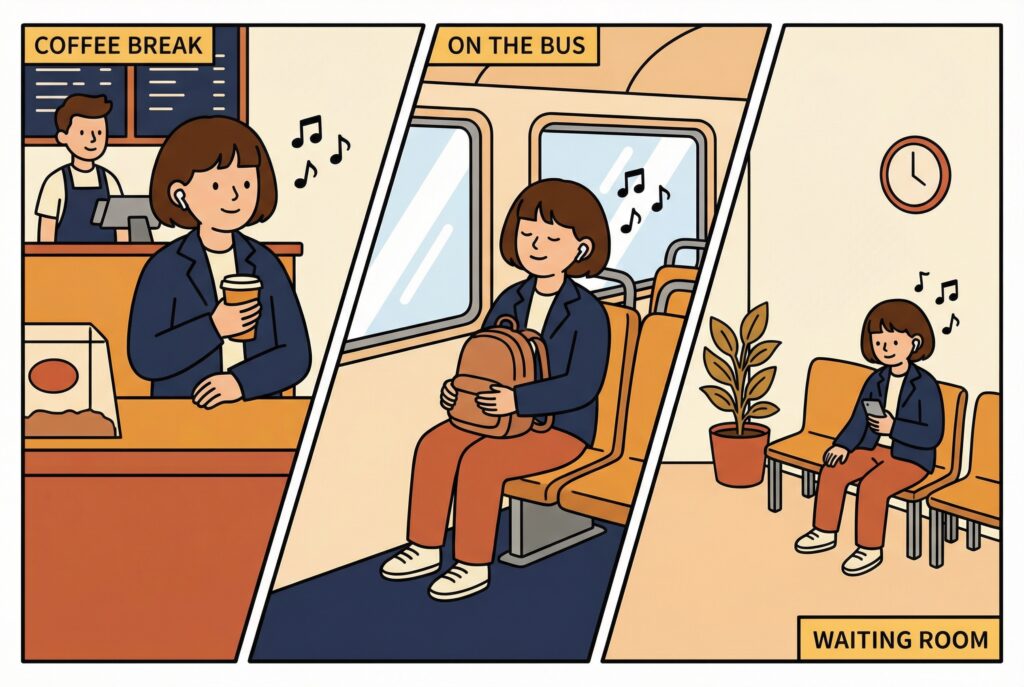
Waiting for coffee? Do a quick interval drill. On the bus? Practice identifying chord qualities.
Embrace Variety
Even if you’ve set aside 30 minutes for ear training, don’t work at the same thing for the entire time. Tackle a wide variety of exercises, with no more than 5-10 minutes spent on any one. This keeps practice fresh and prevents mental fatigue.
Get Support and Structure
Don’t isolate yourself. You need the right materials, environment, schedule, resources, and a community of like-minded people.
Having musically-minded friends helps tremendously. Having a practice buddy is awesome because their ear might perceive things that you don’t. It’s like having two pairs of ears! Not to mention the motivation boost.
Use an Integrated Approach
Rather than treating ear training as completely separate from your musical practice, integrate it throughout. Every practice session should include a mixture of understanding (Head), listening (Hearing), hands-on instrument work (Hands), and awareness of the musical feeling (Heart).
This way, every step forward you take in training your musical ear has direct and immediate payoff for you, with real musical activities.
Learn more
Learn more about Ear Training in Chapter 7: Ear Training in the Musicality book.
Read Now For Free!