Hello and welcome to Bass Tone, Bass Effects Part 1, with me Nick Long, brought to you by
easyeartraining.com. This time around we’re going to be talking about bass effects.
Traditionally, bass players don’t use as many effects as guitarists, but I’m on a mission
to change all that. Used badly, bass effects can render your tone unsubtle and tiring to
listen to, and result in you being totally lost in the mix. But use them well, and you
can achieve sonic nirvana and create brave new bass tones of your very own.
I think much of the bad rap comes from the terrible mess that guitar effects can make of a bass
signal. Recently, specialist bass manufacturers have got in on the scene, and they make a
superb range of pedals which turns all that on its head.
Now as you may have heard me mention before, laptop speakers and small earbud headphones
aren’t particularly good at representing bass frequencies, so when you’re listening to
these examples, try if you can to listen to them on a pair of decent hi-fi speakers or
a pair of big over-the-ear can-type headphones. If you need more advice on getting a decent
hi-fi setup for listening to ear training examples, then you might want to consult my previous series,
wired for sound, which is available on easyeartraining.com.
As usual, I’m going to be playing in some bass tone examples using my trusty Warwick Streamer
Double Buck 5-string, and this time around, instead of playing through an amplifier, I’m going to
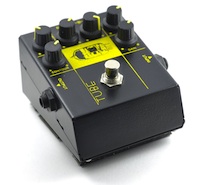
be using a Sans Amp Character Series VT bass pedal. So let’s give you an example of the bass,
which we’ll be playing in the right channel, and you’ll hear my voice, of course, in the left
channel. Now let’s put the VT bass pedal on. The VT bass pedal is set to emulate an Ampeg SVT bass amplifier with a 4×10 speaker cabinet.
All the examples of equalization that I’m going to be giving you will be adjusting the controls on the Sans Amp pedal.
The most common form of sound shaping for bass players is equalization. This is where you boost and cut various frequencies. You may not even really think of this as an effect, but it’s one of the most important ways that you can shape your tone.
In previous parts, we’ve talked about shaping your bass tone with the controls available on your bass, but if you have a passive bass, you may only just have a tone control. The one place we were almost
certain to have some good equalization is on your bass amp. The most common EQ technique is to boost the bass and treble frequencies whilst reducing the mids to give a bottom and top sound. This was particularly popular in 80s music and slap style.
At the moment, I’ve got my amplifier pedal set completely flat, so if we just give you a little example of tone here.
Now, I’m going to boost the bottom and top frequencies whilst leaving the middle in the same place.
Again, with the bass and treble completely flat.
Now, with the bass and treble boosted.
Bass tone is always a trade-off between articulation and low-end thump. For example, dub bass calls for thick, gloopy neck pickup tone that will flap the bass bins and get the reggae girls boggling.
First, I’m going to play a low-down dubby riff that goes all the way down to D with the EQ set completely flat.
Now, I’m going to cut the treble and boost the bass.
Now, I’m going to cut the treble and boost the bass.
Players who favour a high-register melodic or chording approach like Chris Squire of Yes require a toppy sound without too much low-end getting the way of the speedy row.
I’m going to play a riff with some high-register chords played over an A pedal tone. First, I’m going to play with a fairly flat EQ.
Now, I’m going to boost the high frequencies to get more of a
Rush or a Yes type of bass tone.
Many bassists use a compressor or limiter. Unlike with guitar, which uses them to increase sustain and make picking sound clean and level, on bass it’s normally used to tame the percussion-like peaks that result from slap techniques.
A compressor, more precisely called a dynamic range compressor, is a device that reduces the difference in between the loudest and quietest sounds the bass can produce.
The first compressor came out in the days when engineers recorded sound by directly cutting onto a disc with a lathe.
Too much bass would make the blade gouge into the master and ruin the recording.
So, someone invented the compressor to even out the levels.
Wiley producers soon realised that a fat punchy sound came with compression, and since that sound, coming from a jukebox turned heads, they started using it as part of their sonic palette.
The fatness that compression adds is certainly an advantage for bass players, but it offers other benefits as well.
Compression can even out playing dynamics, which as well as hiding a multitude of synths caused by sloppy technique, is especially useful when changing between fingerstyle, slap and pick bass, since each playing technique differs significantly in volume.
More expensive compressors may have a so-called multiband feature. This assigns different compression levels to different frequency bands, meaning you can tame the percussive top end of slap bass without losing the fatness of the low end.
Compression is so ubiquitous among bass players that manufacturers often build it into their amplifiers, in the way that most guitar amplifiers tend to have built-in reverb.
When a compressor built into an amplifier is mainly there to stop the bass overloading the preamp section, it’s generally referred to as a limiter.
Even though a limiter typically can’t be precisely adjusted to shape your tone, they’re fundamentally the same audio effect.
In this example, I’m going to play a single repeated note rising to a crescendo, first with no compression, and in the second example with a compressor engaged.
On the second example, listen out for the compressor levelling off the dynamics.
You can learn more about dynamic range compressors in the hearing effects series available on easyeartraining.com.
Bass players like a bit of filth as much as the next man, unless of course the next man is Russell Brand, but I’d agress.
The unfortunate side effect of applying a regular overdrive sound to bass is a loose and woolly low end, or worse, no low end at all.
The pros get around this by using two bass amps, with one typically running clean and the other one distorted, or by doing what’s known as biamping, which is where the signals pass to two amplifiers by way of a frequency splitter.
This way they can distort the high end, whilst letting the low end go through clean and stay nice and fat.
This has meant for a long time that getting those awesome distorted bass sounds you hear on records by bands like Muse has been out of reach of average Joe bass players like you and I.
But luckily, specialist bass effect manufacturers have recently started to release pedals that solve a lot of these problems.
And there’s two ways they do that. One is by allowing some of the bass frequencies to pass through unaffected, and the other is by blending the clean and bass signals together.
It’s quite similar approaches, but they sound slightly different. I’ll be demonstrating both as we go along.
First of all, let’s look at the kind of dirt you can get with an overdrive pedal.
The pedal I’ve got in front of me today is a multi-drive, which is made by the Swedish bass manufacturers EBS.
The multi-drive circuit is based on the classic Ibanez Tube Screamer distortion pedal.
This is probably the most popular overdrive pedal in the history of guitars, but it doesn’t work very well with bass.
EBS have modified the Tube Screamer circuit by including something called a low-pass filter.
This means that the bass frequencies of your signal pass through unmolested, meaning your sound stays fat.
I can demonstrate this because the EBS pedal allows you to switch this feature on and off.
So first of all, I’m going to play a nice heavy rock riff without any effect at all.
There’s a time and a place for clean bass, but if you want to play rock then you need some dirt.
In this next example, we’re going to use the overdrive with no low-pass filtering.
Now, that was all very nice if you like that kind of thing, but what you’ll notice is there was no real dynamic range.
It sounded very compressed and squashed and the bass frequencies were almost non-existent.
If we flick the switch here, we add the low-pass filter effect.
And if I repeat that riff, you’ll hear it still sounds nice and aggressive and distorted, but it has some of the fatness of the original example.
Sometimes dirt isn’t enough, you need sustain.
Fuzz pedals allow bass players to reach new sonic territories with near infinite sustain and an almost complete lack of dynamics,
which gives a brutal sound, not unlike an analogue synthesizer.
The Electro Harmonix Big Muff is the most popular fuzz pedal among bass players because of its smooth tone and tight bass response.
Many of the stadium rock band music’s biggest hits are based around huge, fat, dirty fuzz-tone riffs.
And this is thanks to their bass player, Chris Wolstenhoom, who’s probably done more than anybody in recent times to popularise fuzz-tone bass playing.
In fact, you could be mistaken for thinking a lot of the riffs on their songs were synthesizers when in fact they’re just bass with a lot of effects applied to them.
I’ve got here with me today an Electro Harmonix Bass Big Muff.
The bass Big Muff is based around the Russian-made Sovtek Big Muff of the early 90s, but it has two important differences which you can use to shape your tone for bass players.
Firstly, it has a bass boost which allows you to replace some of the bass frequencies that are lost by the effect.
And alternatively, it has a blend feature which allows you to add elements of your clean signal back into the distorted signal.
Let’s play a riff in the style of Muse, and then hear it with the Big Muff in its various flavours.
First we’re going to play it clean with pretty flat EQ.
Now let’s use the Big Muff with all the controls set flat in its standard mode.
Now as you can hear, compared to the overdrive, that’s still nice and fat, but it has lost some dynamics.
If we want to boost the bass further, the Bass Big Muff offers a bass boost feature.
Let’s try the same riff with the bass boost engaged.
Try that just to give you a quick example.
Bass boost off.
Bass boost on.
The other, and I think more useful feature, is the ability to blend your clean signal with your distorted bass signal.
I’m going to engage the mode they call dry, which lets you do that.
In the dry mode, your bass signal comes through at the standard volume all the time.
So, this is with the pedal on, but with the volume down at zero.
You can hear my standard bass signal as normal.
If I just play a trill here and then turn the volume knob up, you’ll hear the fuzz tone start to fade in.
An interesting aspect of this is that because the fuzz has almost no dynamic range, but your bass has quite a lot of dynamic range,
if you set the fuzz to a standard volume and then gradually increase the level that you pick,
you’ll go between sounding almost purely fuzzy to sounding almost entirely clean.
I’ll just demonstrate that.
Well, that’s all we’ve got time for.
I hope you’ve enjoyed learning about the grimy world of fuzz and distortion.
Join me next time around when I’m going to be talking about the wobbly, swooshy world of modulation effects.
As usual, if you have any questions, comments, or funny stories, join in the conversation at www.easyeartraining.com slash forum.
My name’s Nick Long, and you’ve been listening to Bass Tone Effects Part 1, brought to you by easyeartraining.com.
Thanks for listening.