Hello and welcome to Bass Tone with me Nick Long, brought to you by Easy Ear Training.
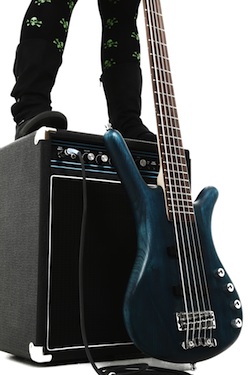
This time around we’re going to be talking about bass amplification.
Picture in your mind a band rocking out and it’s likely you’ll see a wall of roaring amplifiers
behind them, huge 8-speaker cabinets pumping out maximum volume rock and roll. We bass
players have a rather more dependent relationship with our amps than guitarists, as an unplugged
bass doesn’t make very much sound at all. Over the last few years, the range of technology,
shapes and sizes of the bass amp have become almost overwhelming. This time around we’re
going to explore the impact of amps on the elusive quest for bass tone.
Amped Up. A key difference between the bass and the guitar is the approach to amplification,
an electric guitar recorded directly into the mixing desk sounds thin and uninspiring,
while a bass can sound quite acceptable, especially if it has on-board EQ.
We’re about to get pretty technical, so if you need a refresher on amps or distortion,
you might want to look up my series, Wide for Sound Amps and Speakers, or the Hearing Effects
Distortion series, both of which are available on easiertraining.com.
For an electric guitar, the amplifier and speaker are integral parts of the sound.
Guitarists love the harmonics that hard-driving valve amplifiers bring, and the tonal shaping
that the speakers apply. In contrast, bass players typically favour a more hi-fi approach
to amplification. Valve amplifiers with power sufficient to drive a stage rig, due to their
massive size, weight and cost, are relatively rare. Even the majority of professional basses
still choose solid-state amplification rather than valves.
To give you a concrete example, let’s compare the setup of a rock guitarist, in this case
Queen’s Brian May, to a typical bass setup.
In the guitarist’s case, we start off with a booster pedal, cranking up the signal to
overload the pre-amplifier stage of a Vox AC30 amplifier.
The EQ section is quite limited, with relatively subtle tone shaping.
The power amplifier is rated at 30 watts. Cranked to the full power output, it produces power
amp distortion and compression. The power amplifier is rated at 30 watts, and if you’ve ever wondered
why your 30 watt hi-fi amplifier isn’t all that loud, and a 30 watt valve amplifier can
pin you against the wall, there’s two reasons behind it. The first reason is that hi-fi manufacturers
are often quite disingenuous with the quoted wattage of their amplifiers. They actually provide
a figure which is the number of watts that the amplifier could produce just about the point
where it was about to explode, and sounds absolutely terrible. Whereas, weirdly, guitar and bass
amplifier manufacturers tend to supply the figure at which the amplifier is still completely clean.
So when something like an AC30 amplifier, which is rated at 30 watts, is running on 10, it’s actually
probably producing more like 50 watts of output power. Whereas the point at which your domestic
hi-fi amplifier would be starting to sound quite bad, may only be 20 watts of output power.
Another reason is to do with the sensitivity of the speakers, but we’ll talk about that
more when we start talking about cabs.
When the guitar amplifier is cranked to the full power output, it produces power amp distortion
and compression, as it struggles to keep up. In turn, the speakers shape the sound even further
due to their open cabinet running at nearly their full rated output. The speakers in guitar
amplifiers aren’t designed to actually sound hi-fi. Early speakers tended to colour the sound
and create quite a pronounced effect on the mid-range frequencies. Over the years, people
have got used to this effect and it’s actually considered to be desirable. So when a modern
speaker is designed for a guitar amplifier, the engineers will deliberately create a design
which will heighten these particular frequencies. As you can see, the story of the guitar amp is
each section cascading into the next, introducing more harmonics, more compression and more distortion.
In fact, more of everything. All of this limits the options for tonal shaping.
A modern professional bass amplifier on the other hand is in many respects the opposite.
The bassist will typically set input gain with the aid of a peak light just below the level
that might cause clipping in the pre-amplifier. If you’re not familiar with the term clipping,
that’s the point at which the amplifier will begin to distort and not offer a clean signal anymore.
The equalisation section will usually feature at least 4 bands of boost and cut, but could have as many as 15,
and each will have a very wide range of shaping. Because of the bass’s high dynamic range,
it may have a compressor or limiter built in, which stops peak distortion, of which more later.
On bass amps that do feature overdrive, it tends to be more of an add-in effect like a stomp box,
rather than an integral part of the amplifier. While in our guitar example the amplifier was running flat out,
bassists usually don’t find power amp distortion desirable, so they tend to keep their levels in check.
Couple that with the fact that bass frequencies need serious juice to amplify,
and you can see why pro bass amps tend to be a minimum of 300 watts, and may well be over 1000.
Speaker cabinets are enclosed and ported to keep the low end as tight and focused as possible.
Speakers will be designed to comfortably handle their specified power ranges without distorting.
A typical bass cabinet setup might include a large 15-inch speaker to handle the low frequencies,
with smaller 10-inch speakers to handle the mid frequencies, and a tweeter or a horn to handle the high frequencies.
As you can see, a modern bass amp typically presents a far more high-tech hi-fi approach
than the more rootsy approach favoured by guitarists since the 60s.
You should take what I’ve described in this section as a rough guide.
There are some very high-tech guitar amplifiers available, and there are also some bass players who favour vintage 60s valve amplification.
It’s horses for courses, so this is just an overview of what a general setup might look like.
The complexity and flexibility of the EQ section in many bass amps can be intimidating,
and this is where some frequency ear training will pay dividends.
My personal opinion is that amps with dozens of EQ bands are overkill, and I’ve always found that I could dial in a decent tone
with no more than about four decently voiced controls.
Next time you’re at a gig, look over at the bass amp and see if it has one of these huge graphic equalisers with sort of 15 sliders on it.
If it does, see if the sliders have actually been individually adjusted to different levels,
because whenever I look over it’s pretty much always set in a smiley face sort of shape,
which a similar effect can be had really with a three-band equaliser with the mid-cut
and the treble and the bass boosted up a little bit.
Breaking the back or breaking the bank.
There’s four main things that everyone wants out of a bass amplifier.
Great tone, I mean that’s a given.
Earth-shaking power, because otherwise people can’t hear you.
An affordable price, otherwise you simply can’t own the amplifier you want.
And a size and weight that doesn’t present the prospect of back trouble in old age.
Speaking as someone who’s been a gigging musician for longer than I care to remember,
it always catches up with you.
Unless you’re lucky enough to have roadies, you will find yourself struggling and cursing your back
as you load your enormous amplifier into the car.
Unfortunately, as you might have guessed, you can usually only have three of the four.
A cheap and loud amp is usually going to be crushingly heavy,
and the new generation of super lightweight amplifiers and cabinets will usually set you back some serious cash.
In an amplifier, the main factor influencing weight is its efficiency.
An inefficient amplifier needs a big heavy transformer to supply all the power it needs,
and all that inefficiency produces stacks of waste heat.
That leaves the amp needing big heat sinks and fans,
and it will need to be carefully packaged in a big chassis to prevent overheating.
There are quite a few types of amplifier technology on the market today.
The original and classic is valve amplifiers.
Now they sound great, but in terms of bang for your buck, they’re really expensive, they’re very heavy,
and the fact that in a darkened room you can actually see the tubes in a valve amp glowing red hot
should probably give you a clue that they aren’t the most efficient devices in the world.
Class AB transistor based amplifiers are by far the most popular type of amp out there.
They’ve been the gold standard of power to weight ratio for some time,
but there’s some new kids on the block that are really making waves.
Class G amplifiers are very similar to Class AB,
but the main difference is that they change their internal voltage in a clever way to maximise the efficiency.
This can let the amp run cooler, and so allows the amp to be lighter and smaller.
Some high-end manufacturers such as EBS use this kind of technology.
Perhaps the most exciting development in bass amplification over the last few years has been the Class D amplifier.
Class D amps use a technology very similar to that of the switch mode power supply that powers the charge of your mobile phone or laptop.
A Class D amp runs at full power all the time, but switches on and off at very high speeds to create the signal.
This means that the amp can have a near perfect power efficiency, and thus be very small and very light.
The downside of all that switching is the introduction of noise into the signal, which then has to be filtered out.
Because of this, Class D amplifiers are often used in places where sound quality plays second fiddle to raw power,
for example in the amps powering the subwoofers of pimped-out cars.
As a relentless march of technology has allowed faster switching and better filtering,
Class D amplifiers have now moved on to the point they can be used for high quality bass amplifiers as well.
One pioneer of this technology is the lightweight bass amp specialist Mark Bass,
who have attracted the endorsement of some really big name players.
Other manufacturers such as Yamaha, Ibanez and TC Electronic are coming on board too,
ushering in a new era of super light, super loud amplifiers.
Currently you have to pay a hefty price for all that wizardry, but prices should gradually come down,
so perhaps one day you won’t have to make the choice between breaking your back and breaking the bank.
Taking the cab
As if hefting the amplifiers around wasn’t enough bother on its own, you have the speaker cabinet to consider.
For an explanation of the terminology and technology of speaker cabinets, see my Wired for Sound article series.
A bass cabinet needs to be sturdy to dampen any unwanted vibrations,
but large enough to provide the resonant areas and ports that can produce a solid bass frequency.
An unfortunate consequence of this is that some professional bass cabinets can weigh up to 80kg,
that’s £175 in imperial measurements.
For those of us who don’t have the benefit of roadies,
many manufacturers now make relatively lightweight speaker cabinets.
The cabinet walls are light but strong wood ply, poplar as commonly used, sometimes birch.
And the speakers have lighter drivers thanks to the use of powerful but light rare earth magnets such as neodymium.
As with amplifiers, this blending of technology and craftsmanship comes at a cost.
Cheaper cabinets are often made of low-grade particle board, which has less desirable acoustic properties,
and is going to be heavy if you want it to be sturdy.
Speaker cabinets also come in smaller traveller or mini sizes,
but be aware, standard bass cabinets are the size they are for a reason,
and smaller sizes always have compromised low-end projection compared to their larger cousins.
Bass speakers tend to come in three sizes, 10, 12 and 15 inches.
In the past you used to be able to get 18 inch bass speakers,
but I don’t know of any companies that currently produce them.
An enclosure with four 10 inch speakers has long been considered the classic configuration for a bass cabinet.
If you hear bass players going on about a 4×10, that means a cabinet with four 10 inch speakers in it.
Similarly, a 4×12, a 1×15, all these things are just terms meaning the number and size of speakers.
The cabinet I use is a 2×12.
The 2×10 provides a punchy sound with good high frequency reproduction.
10 inch drivers may struggle to reproduce the lowest notes, especially for a detuned or extended range bass.
Often, a bassist will add a second cabinet with a single 15 inch driver to handle the extreme low end.
If you go to a gig and see two cabinets stacked on top of each other,
sometimes they’ll both be the same speaker, but often you’ll notice the one on the bottom will have a single large 15 inch driver,
and the one on top will have 4×10 speakers in it.
Sometimes these are powered by the same amplifier, sometimes the amplifiers are split with the low end going through the 15 inch,
and the higher frequencies going through the 10 inch.
The 12 inch speaker is rather less common in bass cabinets,
but they do provide a very good compromise between the 10 inch and the 15 inch,
where space or budget prevents you from using both.
Manufacturers often fit their bass cabinets out with a single tweeter to provide high frequencies,
and sometimes they attach a horn to reinforce the sound.
A lot of bass players complain that horns add brittleness to the sound,
so look for a cab with an adjustable tweeter, that way you can experiment and find the sound you want.
I could talk about amps for hours, but that’s all we’ve got time for in this episode of Bassetone.
I hope I’ve inspired you to get out there and get those bass bins booming.
If you have any questions or feedback, I’d love to hear from you.
Simply log on to www.easyeartraining.com slash forum.
You’ve been listening to Bassetone, Amplifiers, with me, Nick Long, brought to you by easyeartraining.com.
Thanks for listening.









Hi,
I went through your website on guitar and i found it to be really interesting and innovative.The information and article provided are very useful as well.I really liked it a lot.
Thank
Thanks, Ron!